
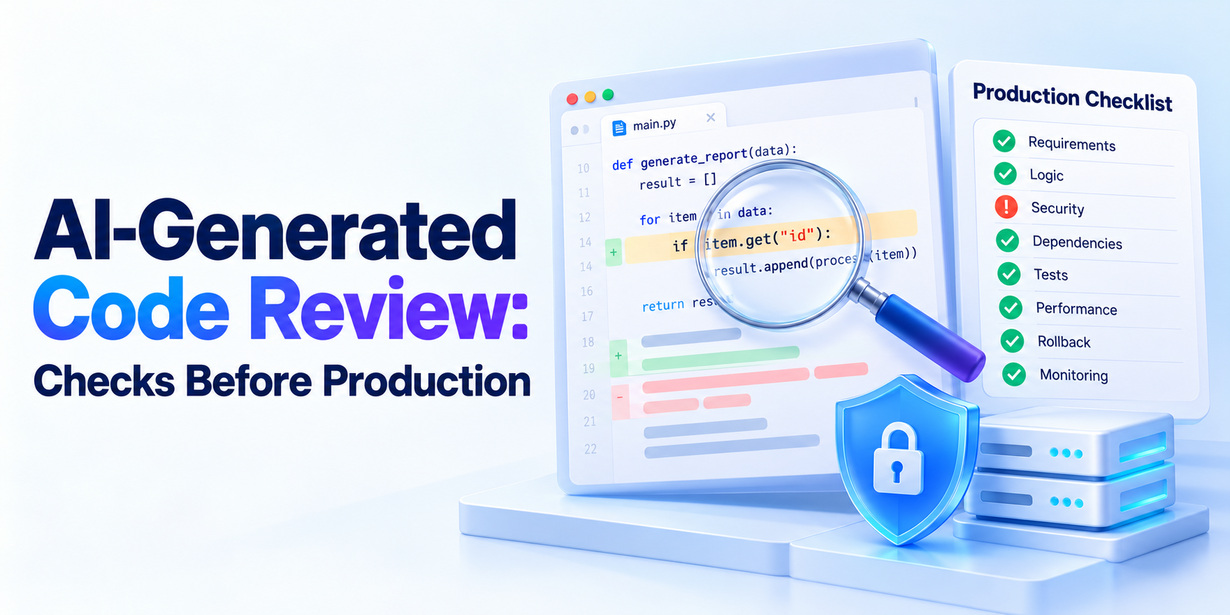
An AI coding assistant finishes an invoice export feature in minutes. The screen looks right, the sample file downloads, and the pull request passes its existing tests. Then someone asks a harder question: can one customer export another customer’s invoices by changing an account identifier?
That is the gap AI-generated code review needs to close. Working code must also follow business rules, protect data, integrate correctly, and remain recoverable when something fails.
Before production, check eight areas: requirements, business logic, security, dependencies, tests, performance, deployment, and operational ownership. Match the depth of inspection to the damage a mistake could cause.
This guide treats AI-generated code review as the assessment of code written or modified by an AI assistant. Whether a human or another tool examines it, the release needs evidence beyond a convincing explanation. The following checks show what that evidence should include.
Why a passing build is only the starting point
A compiler can catch certain language errors. It cannot decide whether a refund policy is correct or whether an employee should access a customer record.
GitHub’s guidance on Copilot’s review limitations acknowledges missed issues, false positives, and potentially insecure suggestions, and recommends human review alongside automated feedback.
Effective AI-generated code review therefore uses several forms of evidence: a readable change, independently chosen tests, security checks, and a release plan. Apply the same quality standards you use for other contributions, while checking assumptions the assistant may have invented.
Start AI-generated code review with scope and requirements
Read the entire change, including configuration, migrations, dependency files, and deployment scripts. A small interface request can arrive with unrelated changes elsewhere.
Write a short acceptance statement before evaluating implementation. For the invoice export example: an authorized account administrator can export only their organization’s invoices, within an agreed date range, without exposing restricted fields.
Then ask:
- Does every changed file support that requirement?
- Does the implementation reuse existing permission and validation mechanisms?
- Are there unexplained feature flags, disabled checks, or altered defaults?
Ask the author to remove unrelated refactoring or submit it separately. Smaller changes make intent and consequences easier to examine.
Classify the change by exposure and impact. A display adjustment and a permission-system rewrite need different scrutiny. Changes affecting payments, personal data, or irreversible operations should receive reviewers with the relevant expertise, even when the diff is short. Record the risk assessment so review effort follows consequences rather than line count.
AI-generated code review should also identify who owns the affected business rule. When developers cannot determine whether a behavior is correct, a product owner must clarify it before approval.
Verify business logic and failure behavior
Trace representative inputs through the code yourself. Comments and AI explanations are claims to verify against implementation.
For an export, inspect date boundaries, time zones, currency handling, empty results, and duplicate records. For payment handling, verify what happens when a request is retried after a timeout. A second request should not accidentally create a second charge; the design needs a reliable way to recognize an already processed operation.
Include failure paths in AI-generated code review. If storage succeeds but a database update fails, what state remains? If a background job crashes halfway through, can it resume safely?
Require an explicit response to partial completion: use an appropriate transaction, compensating action, or retry design. Confirm errors remain visible to monitoring and do not produce success messages. The right approach depends on the system’s boundaries, but silently losing work is never an acceptable default.
Check authorization, input handling, and secrets
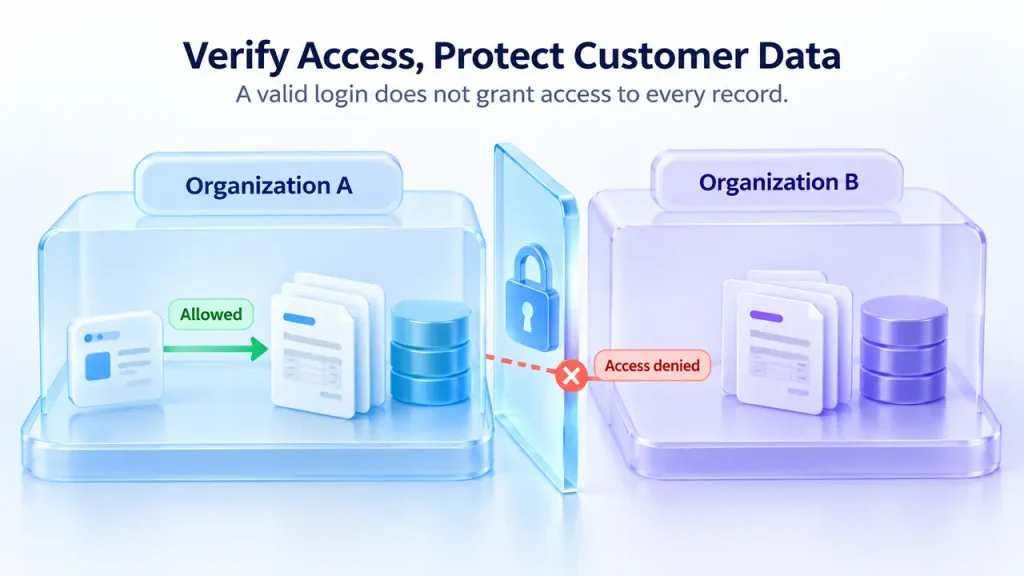
Authentication establishes identity. Authorization determines what that identity may do. A valid login does not establish permission to every record.
Use the OWASP Application Security Verification Standard to structure security requirements and verification. Select controls relevant to the application rather than treating a scan as complete security assurance.
Prioritize these questions during AI-generated code review:
- Are organization and ownership checks enforced on the server?
- Do database operations use parameterized queries where appropriate?
- Are inputs validated and outputs encoded for their destination?
- Could logs, exceptions, or client bundles expose credentials or private data?
- Are file paths, uploads, and outbound requests appropriately restricted?
For the export feature, test with two organizations and attempt access across that boundary. Include direct API requests; hiding a button provides no server-side protection.
If credentials entered source control, remove them and follow the applicable revocation and rotation procedure. Deleting the visible line does not invalidate an exposed secret.
Verify dependencies, APIs, and code provenance
Never install a suggested package solely because its name looks plausible. Confirm its identity in the official registry, inspect maintenance signals and installation behavior, and determine whether the project needs it.
AI-generated code review should verify that every new API call exists in the installed library version. Check official documentation for arguments, response formats, deprecations, and error handling. A convincing method name can still be wrong.
Inspect direct and transitive dependencies, lockfile changes, and runtime compatibility. GitHub’s Dependabot alerts documentation explains how alerts identify vulnerable dependencies and why detection has limits. Add an appropriate dependency check to pull requests; ongoing default-branch alerts alone are not a release gate.
Where required by your delivery process, update the software bill of materials: the inventory of components and versions shipped with the application.
Review licenses and required notices under your organization’s policy. Investigate substantial public-code matches when identified, and retain useful provenance records. A vulnerability scanner does not establish that a dependency’s license fits your intended distribution.
Use independent tests in AI-generated code review
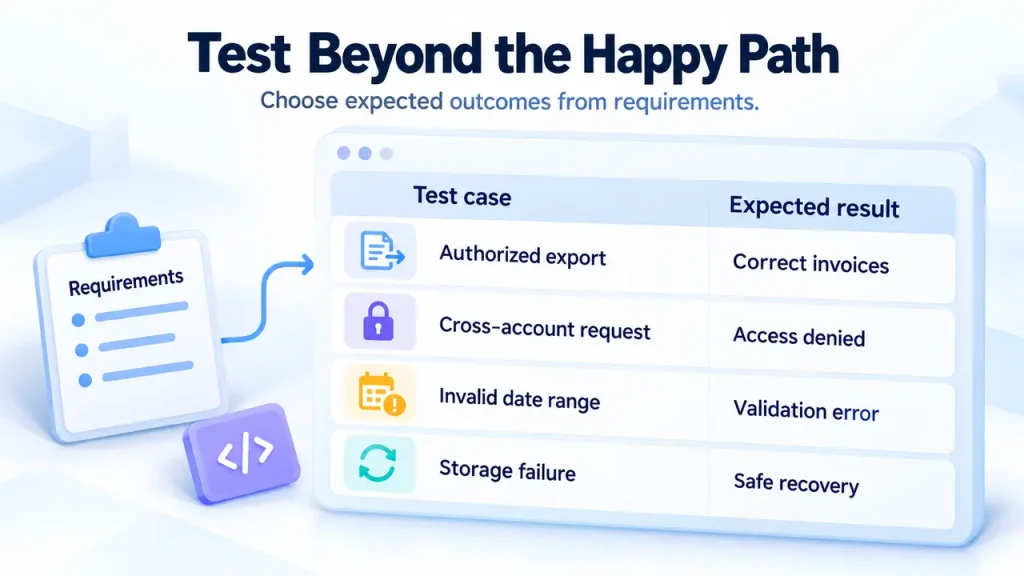
Tests generated alongside an implementation can repeat its assumptions. Derive expected results from requirements and existing contracts, then compare the tests against them.
For the illustrative export feature, useful cases include:
| Scenario | Expected evidence |
| Authorized administrator | Correct invoices and permitted fields |
| User from another organization | Access denied without data leakage |
| Invalid or oversized date range | Predictable validation response |
| Storage or worker failure | Visible failure and safe recovery |
Combine unit tests for isolated rules, integration tests for real boundaries, and an end-to-end check for the critical user journey. Avoid mocking away the database filter or permission service whose behavior you need to verify.
Run applicable linting, type checking, static security analysis, and secret scanning in CI. Inspect changes to the checks themselves: unexplained test exclusions or disabled rules can create misleading results. Keep results tied to the reviewed commit, and rerun affected checks after fixes.
In AI-generated code review, coverage helps locate untested areas; the percentage alone cannot establish correctness. Confirm the test would fail if the targeted defect were present.
If your team needs broader validation, Dropndot’s software testing and quality assurance services cover functional, integration, system, and performance testing.
Assess performance and maintainability
Try realistic data volumes. A function that handles ten records may load an entire customer database into memory when the dataset grows.
Look for repeated database queries inside loops, missing pagination, unbounded retries, expensive synchronous work, and connections that are never released. Measure relevant behavior against the application’s agreed latency, memory, and throughput budgets. There is no universal acceptable response time for every workload.
AI-generated code review should also test whether another engineer can maintain the result. Prefer established project patterns, clear naming, and focused functions. Remove unused helpers, contradictory comments, and abstractions that add complexity without serving a requirement.
For large exports, a background job with bounded resource use may be appropriate. Verify job status, download permissions, and file expiration as part of that design rather than optimizing the export function in isolation.
Include deployment and rollback in AI-generated code review
Run checks against the exact revision intended for release. Confirm environment variables, permissions, database changes, and build artifacts are accounted for. Build and test unfamiliar generated changes in an isolated environment without production credentials.
NIST’s Secure Software Development Framework provides high-level practices for integrating security into the development lifecycle. Translate those principles into project-specific release evidence and clear responsibilities.
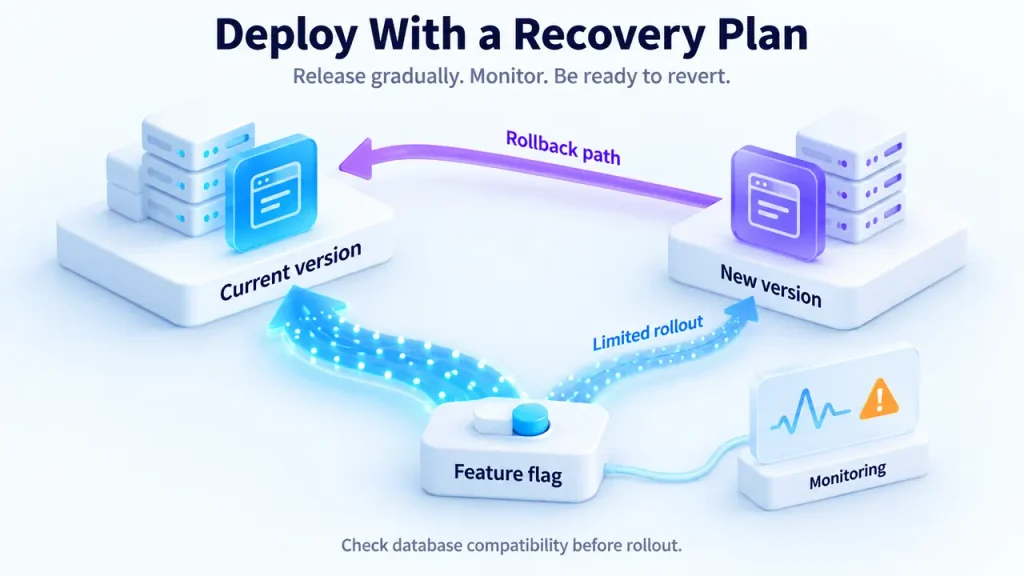
For database changes, check compatibility while old and new application versions overlap. An application rollback cannot automatically recover dropped columns or reverse completed external transactions.
Prefer reversible rollout controls where practical, such as feature flags or a limited initial audience. Document what triggers a stop and how to recover, including forward fixes or tested restoration where rollback is insufficient.
Dropndot’s DevOps and cloud automation services are relevant when these checks need a consistent CI/CD workflow.
Assign ownership and production monitoring
Before launch, name the person responsible for the change and the signals they will watch. For an export service, track failed jobs, queue delays, access-denial patterns, and download errors while keeping sensitive content out of logs.
AI-generated code review is incomplete when nobody owns post-release behavior. Establish an observation window appropriate to traffic and risk, and ensure alerts reach someone who can act.
Use existing service baselines to define investigation thresholds before rollout. A successful deployment followed by growing queue delays still needs attention. Verify that dashboards and alerts actually work rather than assuming the presence of logging provides operational visibility.
For ongoing monitoring, patching, and recovery planning, review Dropndot’s application support and maintenance services.
Make the approval decision explicit
Use the following practical gate for AI-generated code review. It is a suggested workflow, not a certification standard.
| Finding | Release decision |
| Unresolved unauthorized access, exposed secret, or data corruption | Block release and remediate |
| Required behavior untested or integration contract uncertain | Gather evidence before approval |
| Lower-impact issue within accepted policy | Record an owner, rationale, and follow-up |
| Required checks pass and recovery is understood | Approve through the team’s normal process |
Payments, permission changes, and destructive migrations deserve specialist scrutiny proportionate to their consequences.
Common mistakes that weaken review
Avoid approving a large change because its summary sounds confident, accepting generated tests without checking assertions, or suppressing scanner findings simply to obtain a green pipeline.
Another mistake is treating staging as proof of production readiness when its data, permissions, or configuration differ materially. Record those differences and address the relevant gaps. Keep review evidence attached to the pull request so the decision remains understandable later.
Frequently asked questions
What does AI-generated code review include?
It examines AI-authored changes for correctness, security, compatibility, maintainability, and release readiness. The reviewer checks both the implementation and the evidence supporting approval.
Can another AI tool perform the entire review?
It can provide additional feedback, but its findings require verification. Human ownership remains necessary, particularly where business rules, sensitive data, or consequential decisions are involved.
Does every change need penetration testing?
No. Choose testing depth according to exposure and impact. Authentication changes, new public interfaces, and sensitive data workflows may justify specialist security assessment.
Is code safe if all automated tests pass?
Passing tests establish only that the checked expectations held in that environment. Missing scenarios, weak assertions, and inaccurate assumptions can leave important defects undetected.
What should a nontechnical business owner request?
Ask for the acceptance criteria, an accountable reviewer, evidence for important failure scenarios, unresolved risks, and a recovery plan. A working demo covers only part of that evidence.
Should AI involvement be recorded in pull requests?
Follow your organization’s policy. A brief note identifying significant generated changes, verified assumptions, and completed checks can help reviewers focus their attention.
Turn review findings into a release decision
AI-generated code review works best when every important claim has evidence: the business rule is clear, permissions hold, dependencies are understood, tests challenge assumptions, and recovery is realistic.
Start with one upcoming pull request and apply these eight checks. If your project needs engineering help across implementation and production readiness, explore Dropndot’s AI and custom software engineering services and discuss which risks your team needs to address before launch.