
Introduction
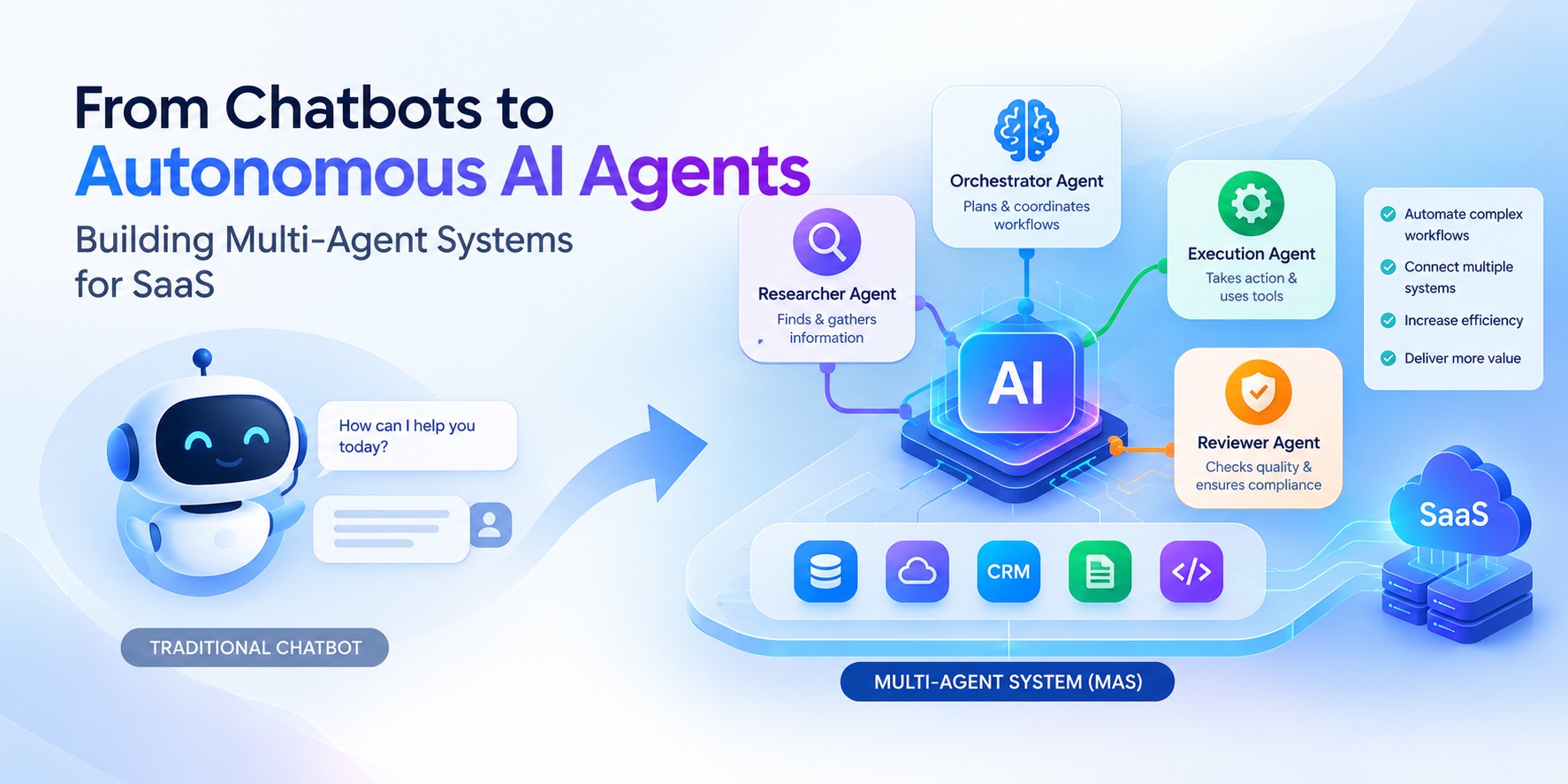
Artificial intelligence has rapidly evolved from simple rule-based chatbots to conversational Large Language Models (LLMs) capable of understanding complex instructions. However, the next major shift in SaaS is moving beyond systems that simply respond to users toward systems that can reason, plan, use tools, and complete tasks autonomously.
Traditional chatbots are useful for answering FAQs, retrieving knowledge from documents, and handling straightforward customer interactions. But modern B2B SaaS workflows are rarely that simple. A customer request may require searching multiple databases, analyzing account information, calling third-party APIs, generating a report, updating a CRM, and asking for human approval before completing an action.
This is where Autonomous AI Agents become significantly more valuable. Instead of waiting for users to provide every instruction, an AI agent can determine the steps required to accomplish a goal and execute those steps through connected tools.
The evolution becomes even more powerful when multiple specialized agents collaborate. A Multi-Agent System (MAS) can divide a complex business objective into smaller tasks and assign them to specialized agents, such as research, execution, analysis, and quality review.
For SaaS companies, this represents a fundamental shift in product design. AI is no longer limited to being a conversational interface; it can become an intelligent operational layer across the entire platform.
Chatbots vs. Autonomous AI Agents: A Paradigm Shift
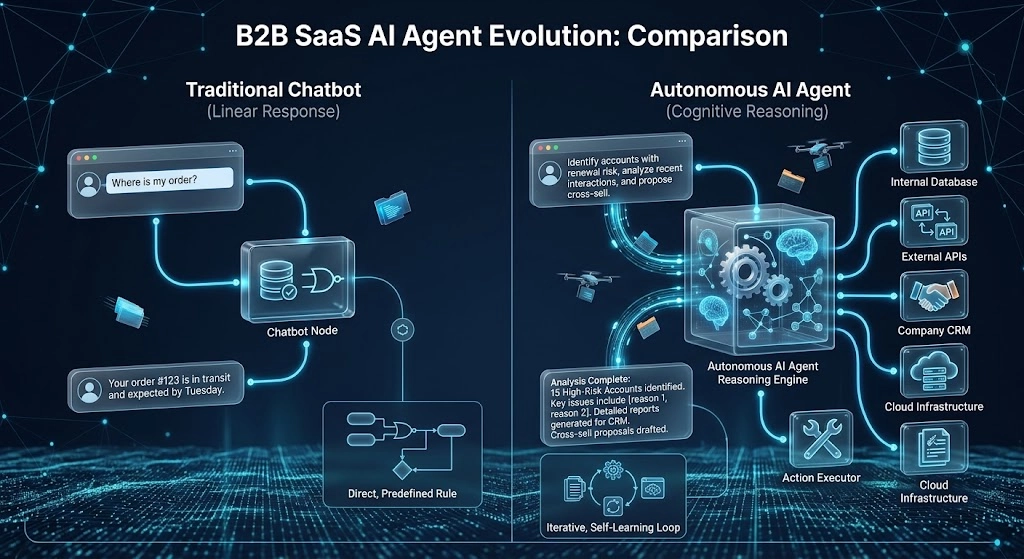
The difference between traditional chatbots and Autonomous AI Agents is primarily about capability and autonomy.
A traditional chatbot typically follows predefined rules or retrieves relevant information using Retrieval-Augmented Generation (RAG). It can understand a question and generate an answer, but it can’t independently complete multi-step workflows.
An autonomous agent, on the other hand, can interpret a goal, create a plan, select appropriate tools, execute actions, evaluate results, and adapt its approach when necessary.
Core Capabilities of AI Agents
Modern agents generally combine five important capabilities:
- Perception: Understanding user requests, application data, documents, and environmental context.
- Reasoning: Determining what the request means and what actions are required.
- Planning: Breaking complex objectives into sequential or parallel tasks.
- Memory: Maintaining relevant short-term context and retrieving historical information.
- Tool Execution: Calling APIs, databases, search systems, CRM platforms, or other software.
This makes Autonomous AI Agents particularly suitable for SaaS environments where completing an objective often requires interaction with multiple systems.
Chatbots vs. Autonomous AI Agents
| Capability | Traditional Chatbot | Autonomous AI Agent |
| Primary role | Answer questions | Complete objectives |
| Reasoning | Limited | Multi-step reasoning |
| Planning | Usually predefined | Dynamic planning |
| Tool usage | Limited | APIs, databases, SaaS tools |
| Memory | Session-focused | Short- and long-term |
| Decision making | Rule or prompt-driven | Context-aware |
| Workflow execution | Mostly manual | Can be autonomous |
| Human involvement | Often every interaction | Used for approvals and exceptions |
For example, a chatbot may answer, “What is the status of this customer’s account?” An agent could retrieve the account, analyze recent activity, identify overdue actions, update the CRM, prepare a summary, and notify the appropriate team.
What Are Multi-Agent Systems (MAS) in SaaS?
A Multi-Agent System is an AI architecture where multiple specialized agents collaborate to achieve a broader objective. Instead of creating one large agent responsible for everything, developers distribute responsibilities among several agents.
Consider a SaaS platform that receives a request to investigate a high-value sales opportunity. A single agent might need to research the company, analyze CRM information, review previous communications, generate recommendations, and prepare an outreach message.
A MAS can divide this workflow among specialized components:
Orchestrator Agent
The orchestrator receives the primary objective, determines the required workflow, and coordinates other agents.
Researcher Agent
This agent gathers information from approved databases, knowledge bases, websites, CRM records, or internal documents.
Execution Agent
The execution agent performs actions such as updating records, sending approved communications, creating tasks, or calling APIs.
Reviewer Agent
The reviewer validates outputs, checks business rules, identifies inconsistencies, and determines whether human approval is required.
This architecture makes Autonomous AI Agents more manageable because each agent has a clearly defined responsibility, toolset, and permission boundary.
Single-agent systems can struggle as workflows become larger because the agent must maintain too much context and manage too many tools. Multi-agent architectures address this by separating concerns and allowing teams to scale individual components independently.
Architecture of a B2B SaaS Multi-Agent System
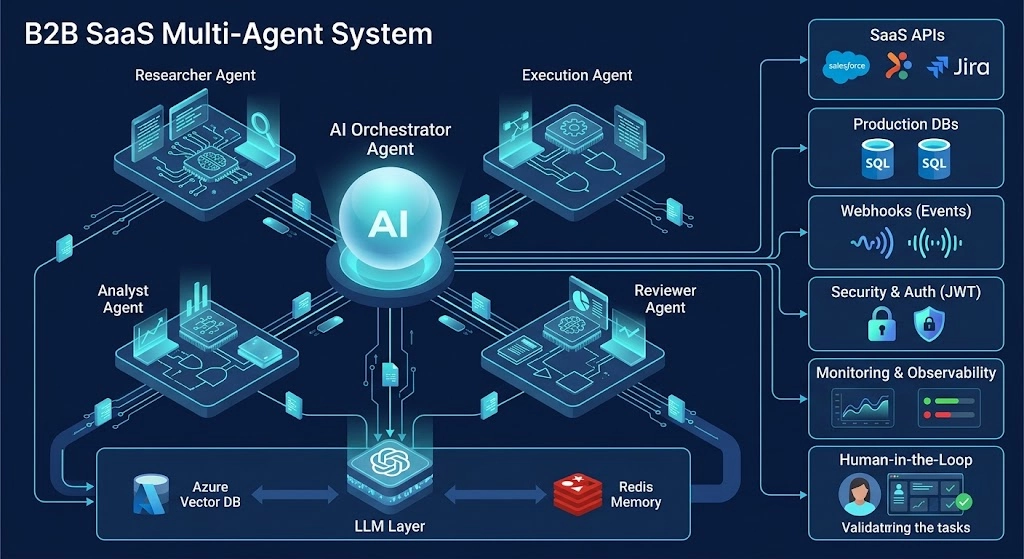
A production-grade Multi-Agent System requires more than an LLM and a prompt. It needs an architecture that controls orchestration, memory, tools, permissions, monitoring, and human oversight.
1. Orchestration Layer
The orchestration layer controls how agents communicate and how tasks move through the workflow.
Frameworks such as LangChain, LangGraph, AutoGen, and CrewAI can help developers implement agent workflows, state management, tool execution, and agent collaboration.
For example, an orchestrator may receive a request such as:
“Analyze this customer, identify potential churn risks, update the CRM, and prepare a retention recommendation.”
The orchestrator could then:
- Ask a research agent to gather customer information.
- Send the information to an analysis agent.
- Ask an execution agent to update the CRM.
- Send the final recommendation to a reviewer.
- Request human approval if a sensitive action is involved.
This type of AI Agent Orchestration creates predictable workflows instead of allowing every agent to act without boundaries.
2. Memory Architecture
Agents need access to the right information at the right time.
Short-term memory maintains the current conversation, workflow state, intermediate results, and recent tool outputs.
Long-term memory stores information useful across sessions, such as customer preferences, historical interactions, business knowledge, or past decisions.
Vector databases such as Pinecone, Weaviate, and Qdrant can support semantic retrieval from large knowledge collections. However, memory should not mean storing everything indefinitely. SaaS architects should define retention policies, access controls, data ownership, and deletion requirements.
3. Tooling and API Integration
The real value of an AI agent comes from what it can safely do—not simply what it can say.
Agents can interact with:
- CRM and ERP systems
- Internal databases
- REST and GraphQL APIs
- Search services
- Email and messaging platforms
- Analytics systems
- Payment platforms
- Project management tools
Function calling allows an agent to select structured tools based on the current task. Webhooks can trigger agent workflows when important events occur, while database queries allow agents to retrieve operational information.
For enterprise SaaS, every tool should have explicit permissions. An agent that can read customer information should not automatically have permission to delete records or send external communications.
4. Human-in-the-Loop
Autonomy does not mean removing humans from every workflow.
Human-in-the-Loop (HITL) controls are essential for sensitive actions involving financial transactions, customer communication, data deletion, compliance decisions, or other high-impact operations.
A practical architecture can allow agents to operate independently for low-risk tasks while requiring approval for high-risk actions. This creates a balance between automation and governance.
Ultimately, successful Autonomous AI Agents should operate within clearly defined boundaries rather than having unlimited access to a SaaS environment.
Real-World SaaS Use Cases for Multi-Agent Systems
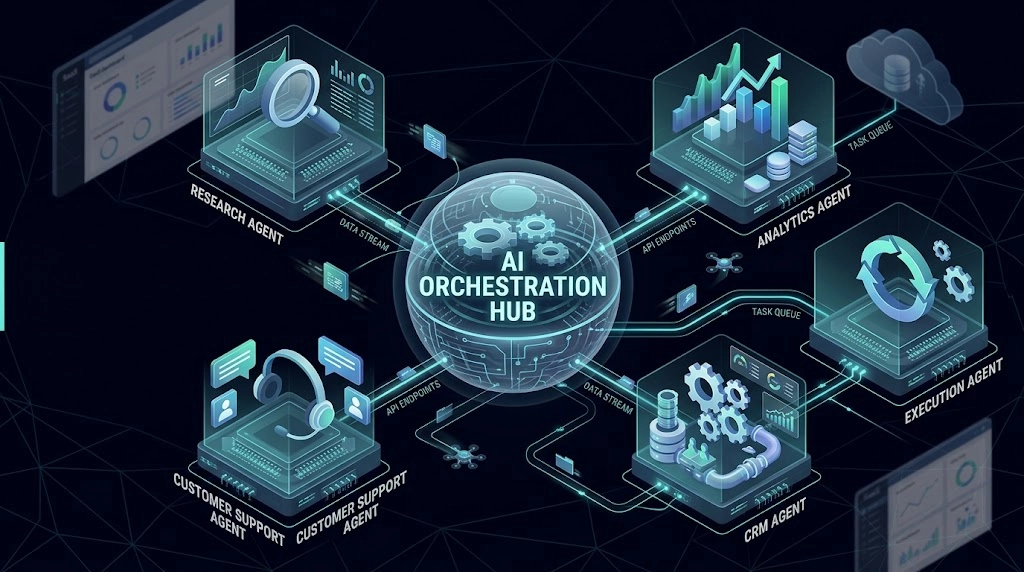
Multi-Agent Systems can support a wide range of B2B SaaS workflows.
Automated Customer Support and Escalation
A support system can use multiple agents to classify customer requests, retrieve account information, investigate technical issues, and recommend solutions.
If the issue cannot be resolved automatically, an escalation agent can prepare a complete case summary for a human support representative. Instead of simply generating a response, the system can actually coordinate the workflow.
Sales and CRM Automation
Sales teams can use Autonomous AI Agents to qualify leads, research companies, analyze CRM history, identify buying signals, and prepare personalized outreach.
For example, a research agent can collect publicly available company information while another agent analyzes CRM activity. A writing agent can then prepare an outreach message based on the combined context, while a reviewer checks the content before sending.
This approach can reduce repetitive sales operations while allowing representatives to focus on high-value conversations.
Data Analytics and Business Intelligence
AI agents can also transform how SaaS teams interact with business data.
A user might ask:
“Show me the customers whose usage dropped significantly this month and explain the likely reasons.”
The system could translate the request into SQL, query approved datasets, analyze the results, generate a report, and send an alert to the relevant team.
With appropriate validation and permissions, agents can turn natural-language questions into repeatable analytical workflows.
Challenges in Building Multi-Agent Systems and How to Overcome Them
Despite their potential, Multi-Agent Systems introduce new engineering challenges.
Agent Drift and Hallucinations
Agents may gradually deviate from their intended role or produce incorrect information. Strong system prompts, structured outputs, validation agents, retrieval controls, and automated evaluations can reduce these risks.
Infinite Loops and Workflow Failures
Agents may repeatedly call tools or pass tasks between each other. Developers should implement maximum iteration limits, timeouts, state tracking, fallback workflows, and circuit breakers.
Cost and Latency
Multiple LLM calls can significantly increase API costs and response time. Teams should route simple tasks to smaller models, cache repeated results, parallelize independent operations, and limit unnecessary agent communication.
Security and Permissions
Enterprise agents must respect user roles and application permissions. Tool access should be scoped according to the user’s authorization, while sensitive data should be protected through encryption, auditing, access controls, and appropriate compliance processes.
The goal is not simply to make Autonomous AI Agents more capable; it is to make them reliable, observable, secure, and predictable enough for production environments.
How Dropndot Helps You Build Enterprise-Grade Multi-Agent SaaS Systems
Building an effective AI agent system requires expertise across AI engineering, backend development, APIs, databases, security, and SaaS architecture.
Dropndot helps businesses design and develop AI-powered software solutions tailored to real operational requirements. From Building AI Agents and intelligent automation to custom API integrations and scalable SaaS platforms, our team can help transform complex workflows into practical AI systems.
Our approach focuses on defining agent responsibilities, designing orchestration workflows, integrating enterprise tools, implementing permission controls, and creating human-approval mechanisms where required.
Whether you are upgrading an existing SaaS product or building an AI-first platform, Dropndot can help you move from basic conversational AI toward production-ready Autonomous AI Agents and Multi-Agent Systems.
Build the Next Generation of AI-Powered SaaS
The future of SaaS is moving beyond systems that simply answer questions. Intelligent, coordinated agents can research, reason, execute, review, and continuously support complex business workflows.
If your SaaS product has repetitive, multi-step processes that require decisions and interaction with multiple systems, it may be time to explore a Multi-Agent architecture.